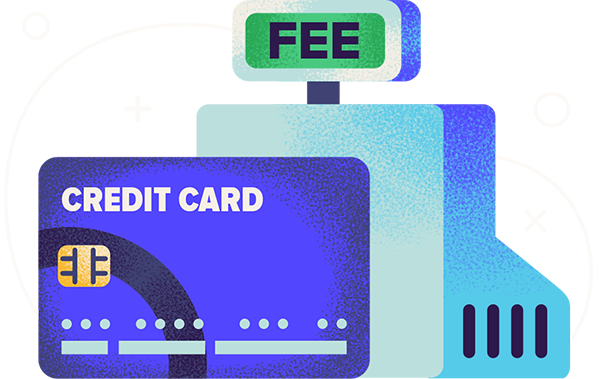


A credit card checkout fee is the extra cost that is sometimes added by merchants for accepting a credit card as a payment method. Many retailers have begun charging these fees as a way to cover the processing fees that they themselves are charged by the credit card networks for receiving credit cards. In turn, we as consumers end up paying more.
But how much are these fees? How can merchants get away with charging them? And do they apply to any other forms of payment? We’ll answer those questions and more below.
How Much Are Checkout Fees?
While checkout fees vary by merchant, card network rules dictate that they cannot exceed more than what merchants pay for their processing costs. In addition to this rule, the checkout fee cannot exceed 4% of the purchase amount – even if the merchant’s processing cost exceeds 4%.
A credit card surcharge can be anywhere from less than 1% to 4% of the customer’s transaction. Therefore, if you make a purchase costing $50, your checkout fee will likely be somewhere between $0.50 and $2.
Are Checkout Fees Even Legal?
The answer is yes and no. A 2012 settlement between credit card networks and a group of U.S. merchants resulted in checkout fees being allowed in 40 states, starting January 27, 2013. The terms of the settlement also required merchants to treat all four credit card networks equally, in the sense that they cannot charge a higher checkout fee for one network over another.
That aspect of the rule was initially significant because American Express required merchants to treat all forms of electronic payment the same. In other words, if a merchant accepted Amex and wanted to apply a surcharge to credit card payments, they would have to do so for debit cards as well. Not only do Visa and Mastercard prohibit debit card surcharges, but merchants generally want to promote debit card transactions given the more favorable swipe fees they carry. A 2013 settlement between American Express and retailers cleared up that catch, however. Merchants who accept American Express can now apply surcharges to credit card transactions without having to do the same to debit cards.
In addition, in 2024, Mastercard and Visa dropped the requirements to treat transactions from all networks equally. According to the new rules, merchants can add up to a 1% surcharge on Mastercard and Visa transactions regardless of how they treat transactions from Amex. They can charge up to 3% on Mastercard and Visa cards if they treat Amex and Discover cards the same way, though.
With that being said, checkout fees still remain illegal in the following three states:
- Connecticut
- Maine
- Massachusetts
It is important to note, however, that according to the Durbin Amendment to the Wall Street Reform & Consumer Protection Act, retailers within these states are still permitted to assess discounts to customers who pay in cash. This essentially produces the same result as a credit card surcharge by rendering cash payments cheaper than plastic, encouraging customers to opt for the former.
Your Rights as a Consumer
Although checkout fees are allowed in most states, there are still regulations in place that protect consumers to a certain extent. As a customer, make sure you know your rights:
- Explicit Disclosure – If a merchant is going to charge checkout fees, it must display notifications at the store’s main entrance and at all points of sale. If you are shopping online, the merchant must explicitly display it on their website (on the landing and checkout pages). Furthermore, merchants must list the dollar amount of the checkout fee as a separate item on your receipt (much like the way “tax” is displayed). Some states also require the merchant to show the full price of an item, including credit card surcharges, up front.
- Fee Limit – A merchant’s surcharge cannot exceed its payment processing cost or 4% of your purchase amount, whichever is lower.
- Only Credit Cards – Merchants can only apply this fee onto credit card purchases. Other cards, including debit cards and prepaid cards, are off limits.
- Refunding – If you return any items to a store that charged you a checkout fee during your initial purchase, the merchant must also refund you the appropriate checkout fee (calculated at the same percentage as the original purchase).
- Reporting – You have the right to report any retailers who violate the aforementioned rules in any way. Violations include charging a checkout fee in a state where it’s illegal, charging a fee that is above the legal limit, failing to fully disclose the application of checkout fees to your purchase, etc. In order to report your retailer, you must contact your respective credit card network.
How to Contact Each Credit Card Network
| Card Network | Phone Number |
| American Express | 1-800-528-4800 |
| Discover | 1-800-347-2683 |
| Visa | 1-800-847-2911 |
| Mastercard | 1-800-307-7309 |

WalletHub's personal finance experts are frequently cited by leading media outlets. Contact our media team to arrange an interview.