

Invoice, purchase order and accounts receivable factoring, or financing, are all pretty much the same thing. They’re short-term liquidity solutions that involve selling rights to expected future income – whether it’s a vendor payment or reimbursement from a credit card company – in return for a lesser amount of up-front capital to be paid out immediately.
This, in turn, enables the seller to fund operations – perhaps needed to fulfill the vendor’s order to pay credit card interchange fees – without having to suffer a potentially debilitating wait for liquidity. The buyer, on the other hand, benefits from a reasonable expectation of turning a quick 3% - 20% return.
Any documented expectation of payment can ultimately be used in this type of financing arrangement, but we’ve highlighted the most common types below. We’ll also provide more detail on the steps involved in a factoring deal as well as the pros and cons of factoring and what alternatives you might want to consider.
How Factoring Works
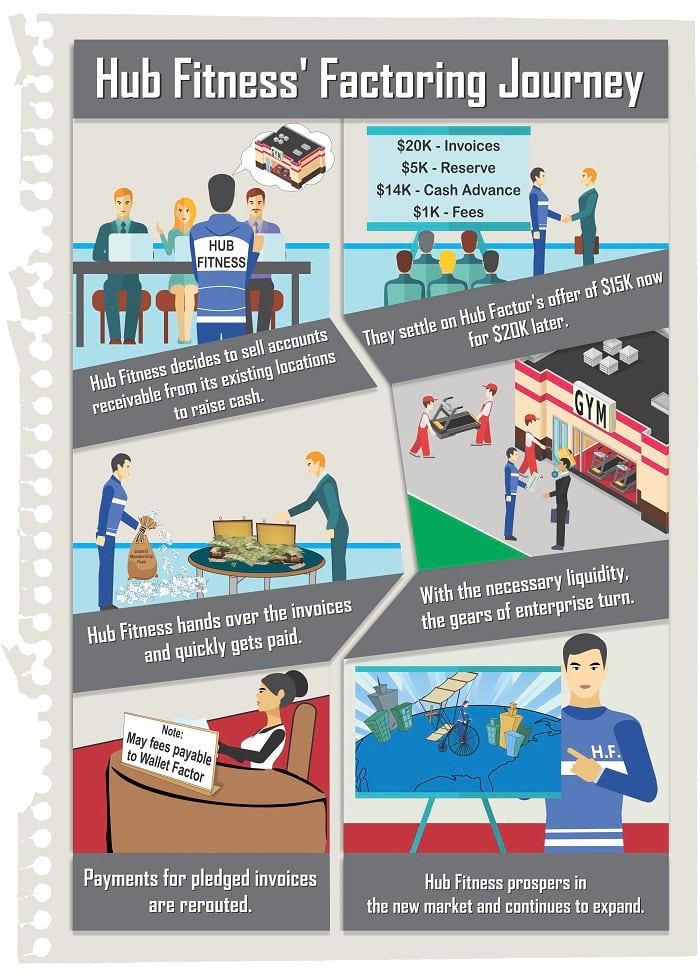
You already understand the gist of how factoring works, but to better familiarize you with the process, allow us to tell you a tale of a fictional company that turns to factoring to satisfy its financial needs. This illustrated portrayal will take you from the small business owner’s initial need for capital to the sale of his or her rights to expected income, and all the way through the resolution of a deal.
Hub Fitness owns a chain of gyms with three locations that do an average of $200,000 in annual revenue and boast a 2,000-person collective client base. The company wants to expand, but the owner’s bad personal credit standing has thus far prevented the company from obtaining the necessary capital.
Management has determined that it will cost $15,000 to rent a suitable property, purchase the necessary equipment and meet payroll for the first month. The company also knows that it shouldn’t take long to become cash flow-positive, based on the launch of its first three locations. And that’s where factoring comes into play.
Types Of Factoring
The primary ways in which factoring agreements differ are in the types of receivable used to secure financing and whether the terms dictate recourse or non-recourse rights. Recourse factoring requires the borrower/seller to repurchase receipts, invoices, etc. that are not paid within the maximum allowable time (e.g., 90 days) stipulated in a contract. With non-recourse factoring, the seller does not assume any such liability.
For a breakdown of the most common types of factoring and an overview of the reputable companies that operate in each space, check out the table below.
| Type | Description | Reputable Companies |
|---|---|---|
| Accounts Receivable (e.g., invoices) | Invoices are the most common type of accounts receivable, but pretty much any legally enforceable claim of payment can be used to secure quick capital. | 1st PMF Bancorp (BBB Accredited: A+ rating)
Capital Plus (BBB Accredited: A+ rating) Finance One (BBB Accredited: A+ rating) United Capital Funding (BBB Accredited: A+ rating) Universal Funding Corp. (BBB Accredited: A- rating) |
| Credit Card Receipts | Some factoring companies will pay cash for unsettled credit card receipts.
And if a factoring company can provide capital faster than credit card companies reimburse your business for amounts spent there, selling these receipts could prove worthwhile – provided you truly need the money. |
Finance One (BBB Accredited: A+ rating) |
| Purchase Orders | The difference between a purchase order and an invoice is that the services being purchased have yet to be paid for in the case of the former.
In many cases, purchase orders can be cancelled, so this is perhaps a less dependable basis for a factoring agreement – especially the recourse variety. |
Factor Funding (BBB Accredited: A+ rating)
Universal Funding Corp. (BBB Accredited: A- rating) |
Factoring Pros & Cons
Factoring isn’t right for every situation. No type of small business funding is. So, we’ve broken down the pros and cons in order to help you make the most informed choice possible, in addition to listing examples of a few situations in which a factored deal might make sense.
| PROS | CONS |
|---|---|
| Provides quick access to capital | You’ll have to take a haircut & will ultimately receive less money |
| Does not involve debt | Typically costs 0.1% of the receivable amount per day, which equates to a XX% APR. |
| You can get approved with bad credit | Factors may want your client’s checks made payable to them, potentially complicating business relationships |
| You can get more capital as receivables grow | Info |
| Fulfills a market need in the absence of significant bank lending | Info |
| It’s better than a payday loan | Info |
Factoring Alternatives
Small business owners have a number of funding options at their disposal – each of which has its own set of advantages and drawbacks, from a scarcity of offers to credit standing requirements and limited capital. However, it’s important to examine all of your options before settling for what could ultimately prove to be a bad deal when placed in the proper context.
Below are the top options to consider. For a full list of small business funding options, check out WalletHub’s Small Business Funding Guide.
- Restructure Order Terms: The need for factoring typically derives from a delay between when a company performs services and when it gets paid. Or, it’s a matter of needing a certain amount of money now in order to make even more money later – the fulfillment of a purchase order, for example. The simplest possible solution would therefore be to alter the timeline so that you get paid sooner after services or with a larger percentage up-front.Of course, not all businesses are in a position to do this. It all ultimately comes down to your relationship with the other party in question and whether you are in a position of leverage. Nevertheless, it usually can’t hurt to ask, so this is definitely an option worth considering.
- Get A Business Line Of Credit, If You Can: A line of credit is particularly useful when you need cash, with amounts up to $2 million available in addition to rates ranging from 5% - 13% and annual fees of $0 - $175. Most banks turn down small business loan/line of credit applications because of the applicant’s poor credit standing, creating a need for costly factoring services. If you have above-average personal credit standing, however, this will be a particularly viable approach, since you’ll be able to qualify for more attractive terms.
- Seek Equity Investors: Liquidating a portion of ownership in your company by selling stock is a quick and immediately inexpensive way to raise cash. However, while a bank or factoring company would assume risk when giving you capital, you assume a certain amount of risk when selling stock. If your company does well in the future, the percentage that you sell now could end up being worth far more than the interest on a loan for the amount you raise.
- Small Business Loan: Taking out a traditional loan probably won’t help satisfy your short-term liquidity needs, but the additional capital could help you avoid needing to entertain the notion of factoring in the future.You can get anywhere from $10,000 to $1 million with a private small business loan, depending on the issuer and your credit standing, though the median amount is roughly $135,000, according to the U.S. Small Business Administration. Loan terms up to seven years and APRs as low as 4.25% are typically available.You may also want to look into an SBA loan, which can be for $5,000 to $5 million, depending on the program, and feature loan terms up to seven years for working capital and rates of 5.5% - 8%.
- Use Personal Assets As Collateral: You may find it easier to get approved for a loan or line of credit if you put up assets to secure the transaction in the event you don’t repay amounts owed. This isn’t the same thing as factoring since you wouldn’t be selling anything, but the potential to lose your home, car or other significant asset still creates risk.

WalletHub experts are widely quoted. Contact our media team to schedule an interview.