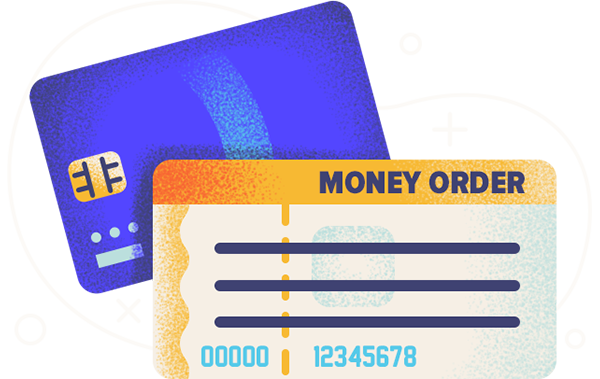


You can’t buy a money order with a credit card in most cases. Even if you find a specific retail location that allows it, credit card companies consider buying a money order to be a type of cash advance, so the transaction will trigger an expensive fee and a high interest rate right away. You should use cash or a debit card to purchase money orders instead.
What Is a Money Order?
A money order is similar to a paper check and used as a form of payment. Unlike a check, a money order is prepaid, so it cannot bounce or be returned, and it clears immediately. However, just like with a check, the recipient of the money can either cash the money order or deposit it into a checking or savings account.
How Does a Money Order Work?
Money orders work very similarly to checks, except you have to buy them individually and they aren’t linked to your bank account. You just have to find a place that offers them, fill out some simple information about the recipient, and pay for your money order, after which the recipient can cash it or deposit the money.
- You visit a location that offers money orders, such as a post office, Western Union or 7-Eleven.
- You ask the cashier for a money order.
- You fill out the money order with the value and the recipient’s name and address, then sign it.
- You pay the amount of the money order, plus whatever fee the issuer charges. Depending on the location, you may be able to pay with a debit card. Otherwise, you can pay with cash. In the rare case that you’re able to pay with a credit card, you’ll also owe a cash advance fee and interest.
- You can either mail the money order to the recipient or hand it over in person.
- Once the recipient of the money order receives it, they can choose to cash it or deposit the money into a banked account, just like they would with a check.
Where Can You Buy a Money Order?
Even though you can’t buy a money order with a credit card at any major establishment, there are lots of places where you can use a debit card to buy a money order. You can also use cash at most stores.
| Company | Accepts Credit Cards? | Accepts Debit Cards? |
|---|---|---|
| 7-Eleven** | NO | YES |
| WesternUnion** | NO | SOMETIMES |
| Kroger | NO | YES |
| USPS | NO | YES |
| Publix | NO | SOMETIMES |
| Walmart | NO | YES |
| MoneyGram* | NO | SOMETIMES |
| CVS (uses MoneyGram) | NO | SOMETIMES |
| Moneytree | NO | NO |
**Varies by location.
You can also get a money order from a local bank or credit union. Naturally, what payment methods you can use will depend on which institution it is. If you have a longstanding banking relationship with the bank or credit union, you may even be able to get the fee reduced or waived.
Is a Money Order Safe to Use?
Money orders are safe to use compared to cash or personal checks. With a check, fraudsters can alter hand written numbers. But on a money order, only the printed amount on the money order can be deposited by the recipient. Money orders also come with a tracking number, where the buyer can track the payment and get a refund if the funds are lost or stolen.
There are scams that involve money orders, but as long as you know and trust the recipient or sender, a money order can be safe to use. To avoid falling for a money order scam, keep money order stubs and receipts, and if you are the recipient of a money order, you should verify where the funds are coming from by calling the issuer of the money order.
Cost of Buying a Money Order With a Credit Card
Credit card companies will treat money order purchases made with a credit card like cash advances. As a result, you’ll trigger an expensive fee and a high interest rate. The fee is 4.01% on average, according to WalletHub’s Credit Card Landscape Report, and the average cash advance APR is 24.5%.
Both will immediately apply to the amount of the cash advance, as there is no grace period on cash advances like there is with purchases. Cash advance fees and APRs differ by credit card issuer but are almost always expensive.
In addition, you will likely pay a fee to the company you buy the money order from, no matter how you pay for it. These fees range from less than a dollar to a few dollars, depending on the company and the size of the money order.
Disadvantages of Buying a Money Order With a Credit Card
- You need to search for the right store. Most locations that sell money orders will only accept cash or debit cards.
- You won’t earn rewards. Money orders purchased with a credit card are considered cash advances and don’t earn rewards, nor do they count toward the spending requirement to earn an initial bonus.
- It’s expensive. Credit card purchases incur a cash advance fee that’s typically 3% to 5% of the transaction amount, on top of the cost of the money order.
- You’ll pay a higher interest rate. Cash advance APRs are usually higher than the card’s regular APR.
- There’s no grace period. Interest on a money order purchased with a credit card accumulates starting from the transaction date and will continue to grow every day until you pay the balance off.
- You may need more than one. Money orders often have a maximum purchase amount. If you want to pay for a $3,000 purchase with a money order and the maximum for one money order is $1,000, for example, buying multiple money orders to cover the cost of the purchase could get expensive.
Should You Use a Credit Card to Buy a Money Order?
You shouldn’t use a credit card to buy a money order, even if you can find a company willing to allow it. Since using a credit card to buy a money order is the same as doing a cash advance, you will have to pay a cash advance fee and interest on top of the amount for the money order. If a credit card is your only option, look for one of the best cash advance credit cards, like one that has no cash advance fees. It’s one way you can save money if you use a credit card to buy a money order.
In addition, you might be interested in learning about ways to send money without using a money order. Below, we'll highlight some options for scenarios where money orders are commonly used.
Credit-Card-Friendly Money Order Alternatives by Type of Bill
1. Utility Bills
Third-party services, such as Plastiq, allow you to pay utility bills with a credit card. However, you will likely need to pay a fee. Some utility companies accept online bill pay from a credit card account, too.
2. Credit Card Bills
You can use a third-party service like Plastiq to pay one credit card’s bill with another credit card. Watch out for fees, though.
Alternatively, opening a 0% balance transfer credit card allows you to move your existing credit card debt to a new card and reduce your finance charges. This is the best option, but it’s more of a one-time thing than a solution for recurring bills.
You could also tap into your credit line with a cash advance and then use the cash to pay your other card’s bill. Credit card cash advances are very expensive, however, so avoid this option whenever possible.
3. Rent Payments
The Bilt Credit Card allows you to pay your rent directly while earning rewards.
In addition, there are a number of third-party services that allow people to pay their rent with a credit card when their landlord does not accept credit directly. Some of the most popular are RentPayment, PlacePay, and ClickPay. Be sure to familiarize yourself with any fees before using these services.
If your landlord will go for it, you could also pay rent with a credit card through a money-transfer service like PayPal or Venmo.
4. Sending Cash to Friends & Family
If both you and your intended recipient have Visa debit or prepaid cards, you can take advantage of Visa Direct to electronically deposit money into their account.
Additionally, you can send money with an American Express credit card using the Amex Send & Split service. This feature allows you to use your card to send money through a linked PayPal or Venmo account, without any of the normal fees.
If you don’t have an Amex card, you can still send money with your credit card through Venmo, PayPal and other money transfer services. However, the transaction will likely be treated as a cash advance, so you’ll owe a costly fee and start accruing interest immediately.
5. Shopping on eBay & Etsy
Another common use of money orders is buying items in certain categories on eBay and Etsy. However, most of these sellers will also accept third-party payment services like PayPal, Venmo and Google Wallet.
PayPal is the easiest way to pay for things on these online marketplaces, especially eBay, as the two used to be part of the same company, so the functionality is thoroughly integrated.
You can also use credit cards and debit cards directly for eBay or Etsy purchases. Using one of the best credit cards for online shopping can save you a lot of money.
For more information about credit substitutes, check out our Credit Card Alternatives Guide.








WalletHub experts are widely quoted. Contact our media team to schedule an interview.