


20
UpvotesCheapest Car Insurance in Texas
WalletHub makes it easy to find the cheapest car insurance companies in Texas.
Cheapest Insurance Rates by Category
Cheapest for Full Coverage: State Farm
Full coverage refers to a policy that goes beyond the minimum state requirements. Because full coverage protects you in more situations, it costs more than minimum coverage.
Learn more about the cheapest full coverage car insurance in Texas.
| Insurance Company | Monthly Rate |
| State Farm | $112 per month |
| Texas Farm Bureau | $127 per month |
| GEICO | $151 per month |
| Germania | $154 per month |
| Nationwide | $165 per month |
Cheapest for Good Drivers: State Farm
State Farm has the cheapest car insurance for most good drivers in Texas. Drivers who have never had an accident or received a citation are considered good drivers by insurers and pay less for insurance than drivers with bad records. In addition to low rates, good drivers can often qualify for additional discounts from their insurance company.
| Insurance Company | Monthly Rate |
| State Farm | $33 per month |
| Texas Farm Bureau | $40 per month |
| GEICO | $46 per month |
| Mercury | $47 per month |
| Germania | $51 per month |
Cheapest for Young Drivers: Texas Farm Bureau
Young, inexperienced drivers pay more for car insurance because they have yet to prove themselves responsible behind the wheel. Young drivers are also statistically more likely to get into an accident than middle-aged drivers. As a result, most drivers will see their rates drop as they age.
| Insurance Company | Monthly Rate |
| Texas Farm Bureau | $74 per month |
| GEICO | $84 per month |
| State Farm | $87 per month |
| Germania | $123 per month |
| Encompass | $145 per month |
Cheapest for Older Drivers: State Farm
Although mature drivers pay less for car insurance than teens, older drivers start to see their rates go up as they enter their senior years. Comparing car insurance rates can save older drivers hundreds of dollars a year.
| Insurance Company | Monthly Rate |
| State Farm | $31 per month |
| Texas Farm Bureau | $34 per month |
| Germania | $46 per month |
| Mercury | $47 per month |
| GEICO | $47 per month |
Cheapest After a Ticket: State Farm
After a speeding ticket, most drivers will see their insurance rates go up for 3-5 years. But each insurance company calculates rates differently, so you should always get multiple quotes to make sure you get the best deal.
| Insurance Company | Monthly Rate |
| State Farm | $33 per month |
| Texas Farm Bureau | $40 per month |
| Germania | $51 per month |
| GEICO | $52 per month |
| National General | $59 per month |
Cheapest for Drivers with One At-Fault Accident: State Farm
One at-fault accident will usually affect your insurance negatively for 3-5 years as insurers will consider you high-risk. Because of your higher rates, it is even more important to comparison shop.
| Insurance Company | Monthly Rate |
| State Farm | $42 per month |
| GEICO | $63 per month |
| Texas Farm Bureau | $68 per month |
| Germania | $72 per month |
| Chubb | $82 per month |
Cheapest for Drivers with a DUI: National General
Drivers who have a DUI on their record typically experience much higher rates than drivers with a clean driving record or people with a history of less severe violations. A DUI usually affects your insurance rates for 3-10 years, but the violation itself may stay on your driving record for much longer than that.
To identify the cheapest post-DUI insurance companies, WalletHub compared rates for a 45-year-old, single man, with minimum coverage, one DUI, and good credit across major insurers.
| Insurance Company | Monthly Rate |
| National General | $60 per month |
| State Farm | $61 per month |
| Mercury | $70 per month |
| Esurance | $72 per month |
| Progressive | $74 per month |
Cheapest for Drivers with Poor Credit: Mercury
A low credit score often flags drivers as higher risk, so insurers will usually charge them more for coverage. However, since insurers use different formulas to calculate premiums, poor credit might affect your rates more with one company than another. Because each insurance company treats credit differently, it pays to compare quotes.
| Insurance Company | Monthly Rate |
| Mercury | $65 per month |
| National General | $78 per month |
| Nationwide | $84 per month |
| Texas Farm Bureau | $85 per month |
| AAA | $91 per month |
Cheapest for Married Drivers: Texas Farm Bureau
Married drivers typically enjoy cheaper car insurance rates than drivers who are single. Auto insurance companies generally view drivers who are married as more responsible and less of a risk to insure. To help married drivers further reduce their insurance costs, WalletHub compared major insurance companies’ rates for a 45-year-old, married man with minimum coverage, a clean driving record, and good credit.
| Insurance Company | Monthly Rate |
| Texas Farm Bureau | $29 per month |
| State Farm | $33 per month |
| Mercury | $42 per month |
| Germania
|
$46 per month |
| National General
|
$50 per month |
Cheapest Car Insurance in Texas by City
| City | Premium | Increase vs. Cheapest City |
| Waco | $1,397 | 0.00% |
| Lubbock | $1,455 | 4.20% |
| Odessa | $1,457 | 4.30% |
| El Paso | $1,472 | 5.40% |
| Amarillo | $1,521 | 8.90% |
| Round Rock | $1,542 | 10.40% |
| Corinth | $1,625 | 16.30% |
| Tyler | $1,647 | 17.90% |
| Fort Worth | $1,661 | 18.90% |
| McKinney | $1,681 | 20.30% |
| Austin | $1,717 | 22.90% |
| Laredo | $1,721 | 23.20% |
| Plano | $1,733 | 24.10% |
| Arlington | $1,765 | 26.30% |
| San Antonio | $1,801 | 28.90% |
| Corpus Christi | $1,827 | 30.80% |
| Sugar Land | $1,835 | 31.40% |
| Irving | $1,841 | 31.80% |
| Grand Prairie | $1,843 | 31.90% |
| Beaumont | $1,850 | 32.40% |
| Mesquite | $1,879 | 34.50% |
| Brownsville | $1,888 | 35.10% |
| Garland | $1,934 | 38.40% |
| Mission | $1,934 | 38.40% |
| Spring | $1,952 | 39.70% |
| Dallas | $2,003 | 43.40% |
| Katy | $2,004 | 43.50% |
| Pasadena | $2,016 | 44.30% |
| Edinburg | $2,072 | 48.30% |
| Houston | $2,128 | 52.30% |
Factors That Affect Car Insurance Premiums in Texas
Recap: Cheapest Auto Insurance Companies in Texas
The cheapest car insurance in Texas is from Texas Farm Bureau, which charges an average of $70 per month for state-minimum coverage. In addition to being the cheapest auto insurer for Texans overall, it is the cheapest option for a number of specific categories, such as good drivers and drivers with poor credit.
For your convenience, we’ve summarized the cheapest companies overall below.
Cheapest Car Insurance in Texas
- Texas Farm Bureau: $70 per month
- State Farm: $73 per month
- GEICO: $86 per month
- Germania: $102 per month
- Nationwide: $133 per month
How to Get Cheaper Car Insurance in Texas
1. Compare quotes from both national and regional insurers
Don’t forget to include local insurance companies in your search for cheap car insurance. In Texas, regional insurers like Texas Farm Bureau might have lower rates than national companies like Allstate, GEICO, and State Farm and have comparable customer satisfaction ratings.
2. Know the factors affecting insurance in Texas
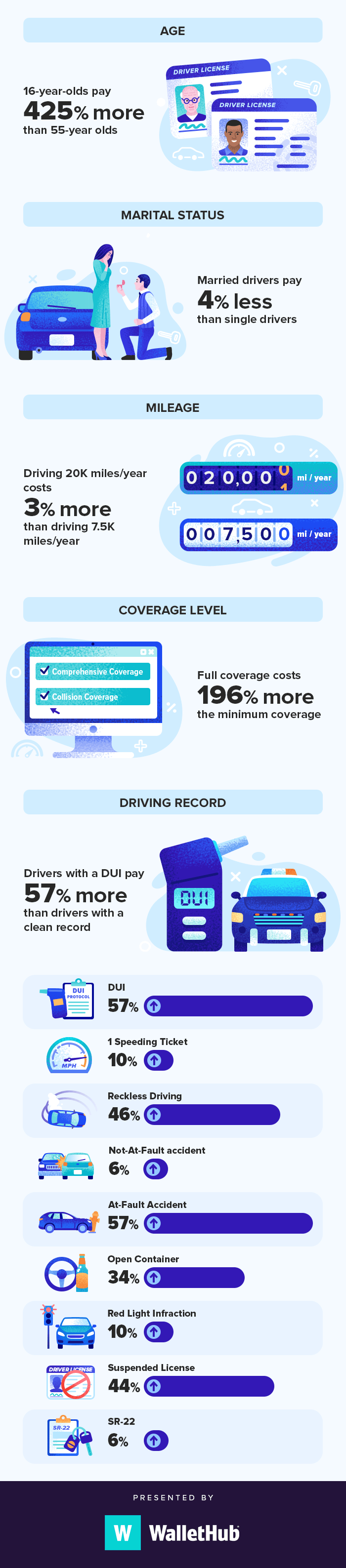
Everyone knows that your driving habits and claims history affect how much you pay for car insurance. But in Texas, companies can also consider your age, gender, credit history, marital status, and more when setting premiums. The car you drive, your annual mileage, and even some factors beyond your control all impact the price of insurance.
3. Choose the coverage that is right for you
You need liability insurance to pay for the other driver’s damages if you’re at fault in an accident in Texas. Collision and comprehensive coverage, on the other hand, are optional and may be unnecessary if you own an older car. Usage-based insurance might be a better fit than a standard policy for low-mileage drivers, and going with a higher deductible or lower coverage limits costs less, too. Don’t skimp on the coverage you need, but do make informed choices. That way, you won’t end up paying for more car insurance than you need.
4. Search for discounts
Top car insurance companies in Texas have a variety of discounts, so almost anyone can find ways to save. You may be able to get a discount if you’re a student, veteran, good driver, homeowner, willing to go paperless, and more.
5. Stay in less expensive ZIP codes
Car insurance prices can vary a lot based on ZIP code in Texas. On average, drivers in the most expensive parts of Texas spend over $900 more per year on car insurance than those living in the least expensive areas.
6. Work on your credit score
In Texas, drivers with no credit pay 92% more than drivers with excellent credit, on average. If you have poor or no credit in Texas, improving your credit score could potentially save you a lot of money on car insurance. You can check your credit score for free on WalletHub if you’re not sure what it is.
7. Maintain coverage
You’ll see higher rates if you let your insurance lapse, even if you don’t own a car. Texas drivers who don’t maintain continuous coverage pay an average of 20% more than those with five or more years of insurance history.
Video: Cheap Auto Insurance in Texas

Methodology for Selecting the Cheapest Auto Insurance in TX
WalletHub’s analysis of cheap car insurance companies in Texas is based on data from the Texas DMV and Quadrant Information Services. Together with that data, WalletHub used the characteristics listed below to create 40 different driver profiles designed to identify the cheapest car insurance companies for Texas drivers in a collection of key categories. For each profile, WalletHub compared quotes among top Texas car insurance companies by averaging premiums from 59 ZIP codes that represent at least 20% of Texas's population. Military-specific companies like USAA were only considered for the military-specific category, due to their eligibility restrictions. In some cases, they may still be the best option overall for eligible drivers.
In the table below, you can see all of the profile characteristics that were used in WalletHub’s analysis, in addition to the specific subset of characteristics that make up our Good Driver profile.
Below are additional details regarding the terminology and specific characteristics of the variables in the above table:
In the table below, you can see all of the profile characteristics that were used in WalletHub’s analysis, in addition to the specific subset of characteristics that make up our Good Driver profile.
| Category | All Profile Characteristics | Good Driver Profile |
| Gender | Male, Female | Male |
| Age | 16, 17, 18, 19, 20, 21, 22, 23, 24, 25, 35, 45, 55, 65 | 45 |
| Marital Status | Single, Married | Single |
| Teenage Driver Included on Policy | No, Yes | No |
| Driving Record | Clean, One Speeding Ticket, One At-Fault Accident, One DUI, Suspended License, Open Container, Red Light Infraction, Reckless Driving, One Not At-Fault Accident | Clean |
| Miles Driven Per Year | 7,500 Miles, 15,000 Miles, 20,000 Miles | 15,000 Miles |
| Coverage Level | Minimum, Standard, Full | Minimum |
| Discounts | None, Multi-Policy, Homeowner, Student | None |
| Credit Level | Poor, Good | Good |
| Filings | None, SR22, FR44 | None |
| Car | Sedan, Minivan, SUV, Coupe, Truck | Sedan |
- Minimum Coverage: Coverage requirements of $30,000 in bodily injury liability per person, $60,000 in bodily injury liability per accident, and $25,000 in property damage liability, as required by Texas's minimum coverage requirements.
- Standard Coverage: Coverage levels of 50k/100k/25k of liability coverage and 50k/100k/25k of uninsured motorist coverage.
- Full Coverage: Coverage levels of 100k/300k/50k of liability coverage, 100k/300k/50k of uninsured motorist coverage, and collision and comprehensive coverage with a $500 deductible.
- Sedan: 2018 Toyota Camry.
- Minivan: 2018 Dodge Grand Caravan.
- SUV: 2018 Toyota RAV4.
- Coupe: 2018 Ford Mustang.
- Truck: 2018 Ford F-150.
Questions & Answers
Finding the cheapest car insurance in Texas can be tough. But you’ve got the knowledgeable WalletHub community on your side. Other consumers have a wealth of knowledge to share, and we encourage everyone to do so while respecting our content guidelines.
Most Popular
- Most Popular
- Most Upvotes
Questions sort
1
Upvote2
Upvotes12
Upvotes5
Upvotes57
Upvotes3
Upvotes2
Upvotes1
Upvote14
UpvotesAsk the Experts
Car Insurance is a necessary expense if you’re a driver in Texas, but trying to find the cheapest rates can be a time-consuming process. To help you learn more about getting cheap car insurance without sacrificing quality coverage, WalletHub posed the following questions to a panel of experts in Texas. Click on the experts below to view their bios and answers.
- What does it say about car insurance companies that so many have celebrity endorsers?
- Do you think it’s fair to say that car insurance companies try to mislead customers or is it just marketing?
- Is it fair for car insurance companies to consider gender or age when setting premiums?
- Is it fair for car insurance companies to consider a driver’s occupation when setting premiums?
- Do you think car insurance companies are fair to college students?
- What advice do you have for new drivers when it comes to car insurance?
- How do you think increased adoption of electric vehicles will change the car insurance landscape?
- To what extent has technology disrupted the car insurance industry relative to others?

Ethan Pew
Ph.D., Clinical Assistant Professor | Director, Master of Science in Marketing - The University of Texas at Austin | McCombs School of Business
Read More
Ph.D., Clinical Assistant Professor | Director, Master of Science in Marketing - The University of Texas at Austin | McCombs School of Business
Read More

Alexandre Aidov
Ph.D., Associate Professor of Finance, College of Business, University of Houston – Victoria
Read More
Ph.D., Associate Professor of Finance, College of Business, University of Houston – Victoria
Read More

Bill Eisele
Ph.D., P.E., PMP, Associate Agency Director, Senior Research Engineer, Regents Fellow, Texas A&M Transportation Institute
Read More
Ph.D., P.E., PMP, Associate Agency Director, Senior Research Engineer, Regents Fellow, Texas A&M Transportation Institute
Read More

Dr. Lisa Jenkins
PT, MPT, Ed.D., Associate Director of Clinical Education (ADCE) / Assistant Professor, University of St. Augustine for Health Sciences
Read More
PT, MPT, Ed.D., Associate Director of Clinical Education (ADCE) / Assistant Professor, University of St. Augustine for Health Sciences
Read More

Mahesh (Michael) S. Raisinghani
Ph.D., Professor, MBA Program, MAK College of Business and Entrepreneurship, Texas Woman's University
Read More
Ph.D., Professor, MBA Program, MAK College of Business and Entrepreneurship, Texas Woman's University
Read More

Michael Spohn
Lecturer at Texas A&M University-San Antonio
Read More
Lecturer at Texas A&M University-San Antonio
Read More
More Experts