
What Is No-Fault Insurance?
No-fault insurance is a system of car insurance laws that requires drivers to use their own coverage to pay for basic medical expenses after a car accident, regardless of fault. The term “no-fault insurance” often refers to personal injury protection (PIP), as well, because PIP is required in almost all of the 12 no-fault states. This ensures that all drivers are able to get care for their injuries and compensation for the cost without first determining who caused an accident.
What Does No-Fault Insurance Cover?
- Medical expenses
- Funeral expenses
- Lost income
- Child care expenses
- Survivors’ loss
- Household services
No-fault insurance does not apply to property damage or other drivers' expenses. You can get other types of insurance for those things, even in no-fault states.
How No-Fault Insurance Works
No-fault insurance pays for your medical bills and related expenses if you are injured in a car accident, regardless of who caused the wreck. The 12 no-fault states require drivers to carry personal injury protection (PIP) in order to cover their medical expenses. Since all motorists carry mandatory first-party coverage, people hurt in a car accident are not permitted to sue the other driver for compensation unless their injuries are severe or their bills exceed a certain amount.
It’s worth noting that no-fault insurance only applies to medical bills after a car accident, and does not include car repairs. So if your vehicle is damaged in an accident in a no-fault state, the at-fault driver is still responsible for reimbursing you through their property damage liability insurance.
Learn more about how no-fault insurance works.
Benefits of No-Fault Insurance
- Drivers can have their medical claims paid quickly after an accident, since fault doesn’t matter.
- Insurers spend less money on litigation and pass the savings to customers.
- The PIP required in no-fault states covers other expenses in addition to medical bills, including child care and household services.
Learn more about the benefits of no-fault insurance.
Types of No-Fault Insurance
Of the 12 states with no-fault laws, nine follow the standard model for no-fault insurance, while three make no-fault insurance optional. Additionally, there are eight at-fault states that offer “add-on” no-fault insurance, which gives drivers no-fault coverage without the strict requirements for filing a lawsuit.
“Choice” No-Fault Insurance:
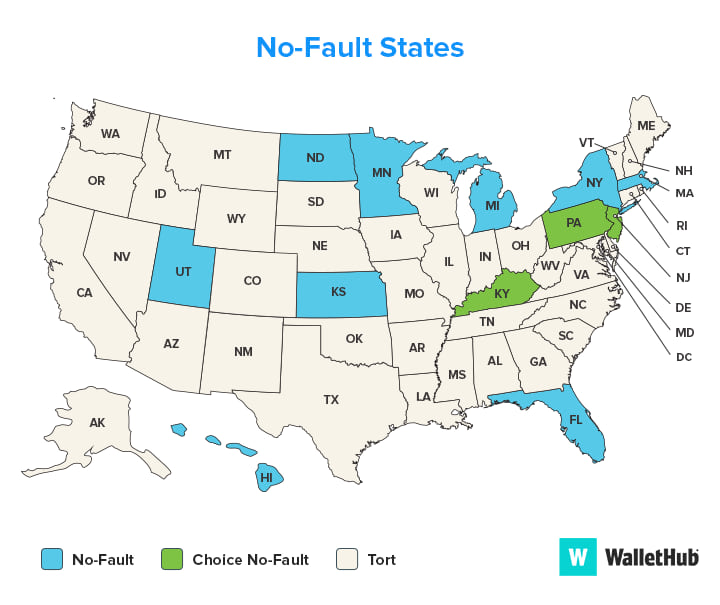
Three of the 12 no-fault states allow consumers to opt out of the no-fault system: Kentucky, New Jersey and Pennsylvania. They are sometimes referred to as “choice no-fault” states.
- Kentucky: Consumers can reject PIP insurance and limitations on their right to sue by filing a form with the state department of insurance.
- New Jersey: Consumers can choose “unlimited right to sue” insurance and thereby opt out of the no-fault system.
- Pennsylvania: Consumers can choose a “full tort” policy, which means opting out of the no-fault system.
“Add-on” No-Fault Insurance:
In addition to the 12 no-fault states, eight other states and the District of Columbia require or make personal injury protection (PIP) optional but do not limit their ability to sue an at-fault driver after an accident. Because these states don’t limit injury lawsuits, they technically aren’t considered “no-fault,” though some still require drivers to have PIP.
- Arkansas: PIP is optional, but insurers must offer it
- Delaware: PIP is required ($15,000 per person and $30,000 per accident)
- District of Columbia: PIP is optional
- Maryland: PIP is optional, but insurers must offer it
- Oregon: PIP is required ($15,000 per person)
- South Dakota: PIP is optional
- Texas: PIP is optional, but insurers must offer it
- Virginia: PIP is optional
- Washington: PIP is optional, but insurers must offer it
Learn more about different types of no-fault insurance.
How Much Is No-Fault Insurance?
No-fault insurance costs an average of $897 per year, for state-minimum coverage. The exact cost of no-fault insurance depends on several factors including your state, how much coverage you purchase, your driving history, and your insurance company. Liberty Mutual and Travelers are the cheapest no-fault insurance companies overall.
Cheapest No-Fault Car Insurance Companies
The list above is based on data collected in Florida, the largest no-fault state.
Learn more about how much is no-fault insurance.
No-Fault Insurance States
No-fault insurance only matters to you if you live in one of the states highlighted in blue or green on the map below.
No Fault Insurance Requirements by State
| States | PIP Coverage Requirements |
|---|---|
| Florida | $10,000 |
| Hawaii | $10,000 |
| Kansas | $4,500 |
| Kentucky | $10,000* |
| Massachusetts | $8,000 |
| Michigan | $250,000 |
| Minnesota | $40,000 |
| New Jersey | $15,000 |
| New York | $50,000 |
| North Dakota | $30,000 |
| Pennsylvania | $15,000 |
| Utah | $3,000 |
Note: As of January 2023
*Kentucky allows drivers to reject PIP coverage in writing.
**Michigan allows Medicare enrollees to opt-out of PIP.
***Pennsylvania requires drivers to carry medical payments coverage, not necessarily PIP.
The remaining 38 states are “tort” states, which have a different system for paying for minor injuries.
Learn more about no-fault insurance states.
No-Fault States vs. Tort States
The alternative to “no-fault” insurance laws is a “tort” system of insurance for personal injury claims. In “tort” states, the at-fault driver and their insurance company are responsible for compensating individuals that they injure in a car accident. There are also no restrictions on the right to sue after an accident in tort states, even if a motorist chooses to purchase PIP insurance.
Comparing No-Fault and Tort States
| State Type | No-Fault States | Tort States |
|---|---|---|
| Who pays basic medical bills? | Each driver is paid by his or her own insurer. | At fault driver's insurer pays medical bills. |
| PIP insurance | Replaces compensation that would have been collected from an at-fault driver. | Supplements compensation collected from the at-fault driver. |
| Claim payment time | With no need to establish fault, insurance claims are paid quickly. | Insurance claims may not be paid until after fault is determined, sometimes after a lawsuit. |
| Right to sue | State law limits the rights to sue the at-fault driver unless injuries are severe. | No limits on right to sue at-fault driver based on severity of injuries. |
Tips for Selecting a No-Fault Insurance Limit
Your no-fault car insurance limit is the maximum dollar amount that your insurance company will pay under your personal injury protection insurance. In addition, drivers in no-fault states will need to choose liability insurance limits, and you may need to choose an uninsured motorist insurance limit, depending on your state’s requirements.
Choosing insurance limits is important since choosing a low limit may mean you do not have enough coverage in the event of an accident. Here are some tips to help you make the right decision:
- Look at your state requirements. You need to purchase at least your state’s minimum coverage requirements in order to drive legally. However, its recommended you purchase higher limits than your state requires.
- Consider how any dependents would be affected. PIP insurance can cover the loss of your income for any surviving dependents. If you have family members or others who rely on your income, opting for a high PIP insurance limit will help ensure their financial stability. On the other hand, if others are not financially reliant on your income, you may want to opt for a low coverage limit to save money on your premiums. It is worth noting that this benefit may be subject to certain restrictions depending on your state. For instance, in Kentucky, your dependents may only receive a maximum of $200 per week for lost income.
- Evaluate your existing health insurance coverage. If you have comprehensive health insurance, you may not need as much PIP coverage. In this case, you could choose a low PIP limit to save on your premiums. However, even if you have health insurance, it is likely still worth purchasing PIP if your state offers it, since PIP can offer coverage for situations that health insurance would not cover. For instance, PIP insurance may reimburse you for lost wages while you’re unable to work due to an accident-related injury, which health insurance does not cover.
- Consider your existing life insurance policy. Life insurance policies typically cover funeral expenses and can include a “death benefit,” or a sum of money to be paid to the named beneficiary. If you have a life insurance policy, you may not need high PIP limits, since your dependents would receive financial help from your life insurance policy already. However, it’s important to note that your life insurance policy will only apply in the event of your death. If you are purchasing PIP insurance for its benefits that are not contingent on your death, then your existing life insurance policy should not factor into your decision regarding your PIP limit.
- Assess your driving habits. If you frequently drive in heavy traffic or in areas with a high accident rate, you may want to consider high coverage limits to protect yourself in case of an accident.
- Determine what is within your budget. Take the time to shop around and get quotes from several different insurance companies. Compare coverage limits, deductibles, and premiums to find the policy that best fits your needs and budget.
Video: No-Fault Insurance Explained

Ask The Experts
To gain more insight about no-fault insurance, WalletHub posed the following questions to a panel of experts. Click on the experts below to view their bios and answers.
1. What are the advantages of no-fault insurance laws?
2. What are the disadvantages of no-fault insurance laws?
3. Should drivers get PIP coverage even if it is not required?
Ask the Experts

Ph.D., CPCU, AAI, CRIS, CICS, Robert F. Bird Distinguished Professor of Risk & Insurance - Director of Risk Management & Insurance Program - College of Business, East Carolina University
Read More

Ph.D., Professor, Department of Urban and Public Affairs - University of Louisville
Read More

DHA, MBA, Assistant Professor of Health Sciences - Saginaw Valley State University
Read More

Ph.D., FRM, ACUE - Clinical Assistant Professor, MS Quantitative Finance Advisor, Finance and Real Estate Department, College Of Business - The University of Texas At Arlington
Read More

Ph.D., ASA, Associate Professor and Academic Director, Actuarial Science Program - Fox School of Business, Temple University
Read More

Senior Lecturer of Finance, College of Business, Stony Brook University
Read More









WalletHub's personal finance experts are frequently cited by leading media outlets. Contact our media team to arrange an interview.