














Methodology
WalletHub’s Key Rating Components
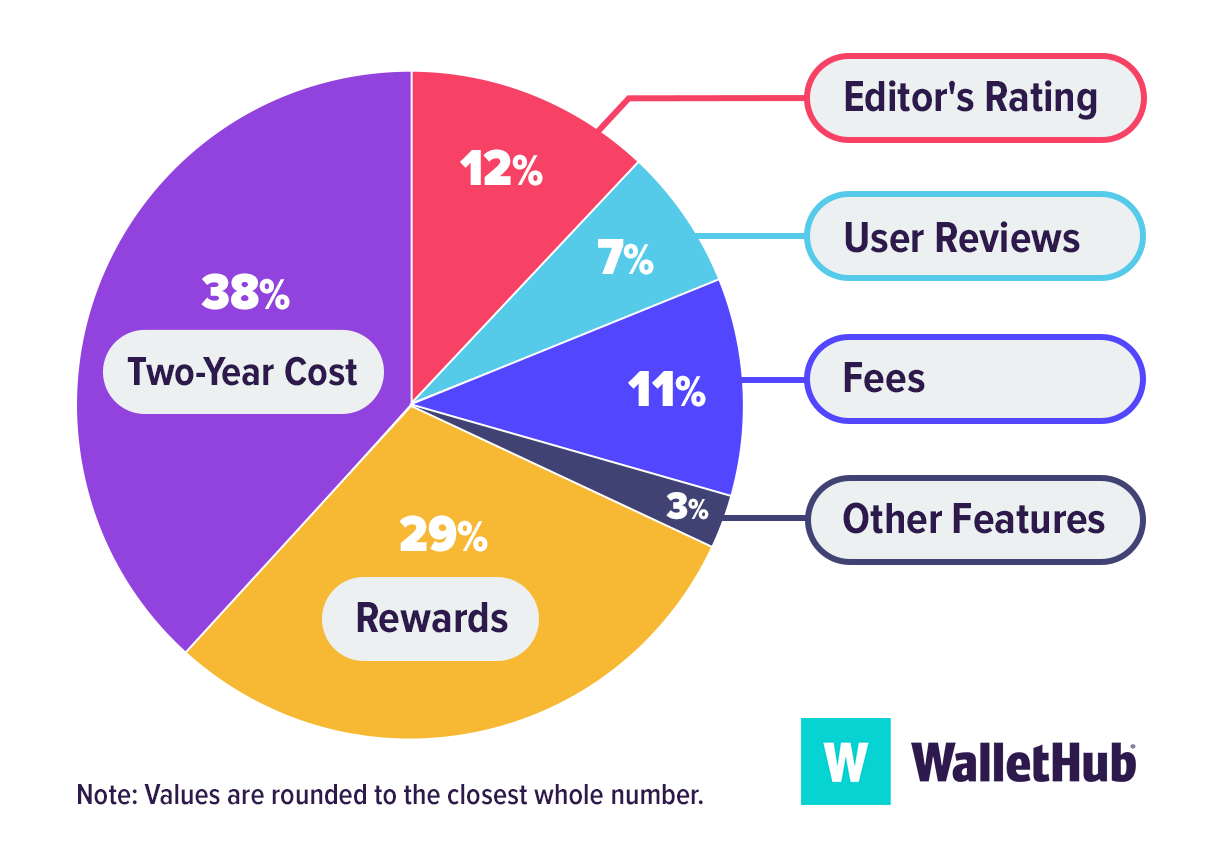
Two-Year Cost: 38% – We project the overall value of keeping each card for two years by weighing its annual fees against the rewards and benefits a typical cardholder could earn during that period. Because these cards do not charge foreign transaction fees, we also consider the potential savings for people who frequently make purchases abroad.
Rewards: 29% – We assess how well each card rewards both international and everyday spending. This includes evaluating base earning rates, bonus categories, and how flexible and valuable the redemption options are for cardholders.
Editor’s Rating: 12% – Our editorial team reviews each card’s overall competitiveness, focusing on its rewards structure and how reliable it is for both international and everyday spending.
Fees: 11% – We analyze the costs associated with each card, including annual fees and other potential charges.
User Reviews: 7% – We include feedback from cardholders to capture real-world experiences with international acceptance, rewards programs, customer service, and overall satisfaction.
Other Features: 3% – We also consider additional benefits such as travel protections, and rental car insurance, purchase protections, and perks like airport lounge access or Global Entry/TSA PreCheck credits that can add value for cardholders who make purchases outside the United States.
Certain cards highlighted on this page may be evaluated using a slightly adjusted scoring method to reflect variations in eligibility criteria. This includes cards intended for students as well as those designed for individuals with lower-than-average credit scores.
How Two-Year Cost Is CalculatedTwo-year cost is used to approximate the monetary value of cards for better comparison and is calculated by combining annual and monthly membership fees over two years, adding any one-time fees or other fees (like balance transfer fees), adding any interest costs, and subtracting rewards. Negative amounts indicate savings. When fees or other terms are presented as a range, we use the midpoint for scoring purposes.
Rewards bonuses and credits have been taken into account for two-year cost calculations. However, bonuses applicable to only a very small portion of cardholders are not considered. For example, credits and bonuses awarded for spending or redeeming rewards through a company portal with non-co-branded cards have not been taken into account. Similarly, bonuses and credits related to spending with specific merchants using a non-co-branded card have not been taken into account (for example, if Card A offers credits with DoorDash, this feature would not be factored into calculations because it is hard to assess how many cardholders would use the benefit or exactly how much value they'd get from it).
Cardholder Spending Profiles
Given that different users have different goals and are likely to use their credit cards differently, we identified spending profiles that are representative of different users’ financial priorities and behaviors. For each cardholder type, we have assumed a specific amount of monthly spending by purchase type (e.g., groceries, gas, etc.), as well as an average balance, balance transfer amount, amount spent on large purchases and average monthly payment. Spending assumptions are based on Bureau of Labor Statistics data for consumers and PEX data for businesses.
Sources
WalletHub actively maintains a database of 1,500+ credit card offers, from which we select the best no foreign transaction fee credit cards for different applicants as well as derive market-wide takeaways and trends. The underlying data is compiled from credit card company websites or provided directly by the credit card issuers. We also leverage data from the Bureau of Labor Statistics to develop cardholder profiles, used to estimate cards’ potential savings.