




Methodology
To identify the best American Express business credit cards, WalletHub’s editors routinely compare all of the Amex business credit card offers from our database of 1,500+ cards based on key WalletHub Rating components. We begin by estimating how much each Amex business card is likely to save the average cardholder, based on spending data from the Bureau of Labor Statistics and assuming cardholders pay their monthly bills in full in order to avoid interest. This makes it easy to select the best American Express business credit card in popular categories such as cash back and travel rewards.
In addition, even though business credit cards can be risky to carry a balance on, we also evaluate Amex business credit cards with 0% introductory APRs to see which offers figure to save cardholders the most on financing.
WalletHub’s Key Rating Components
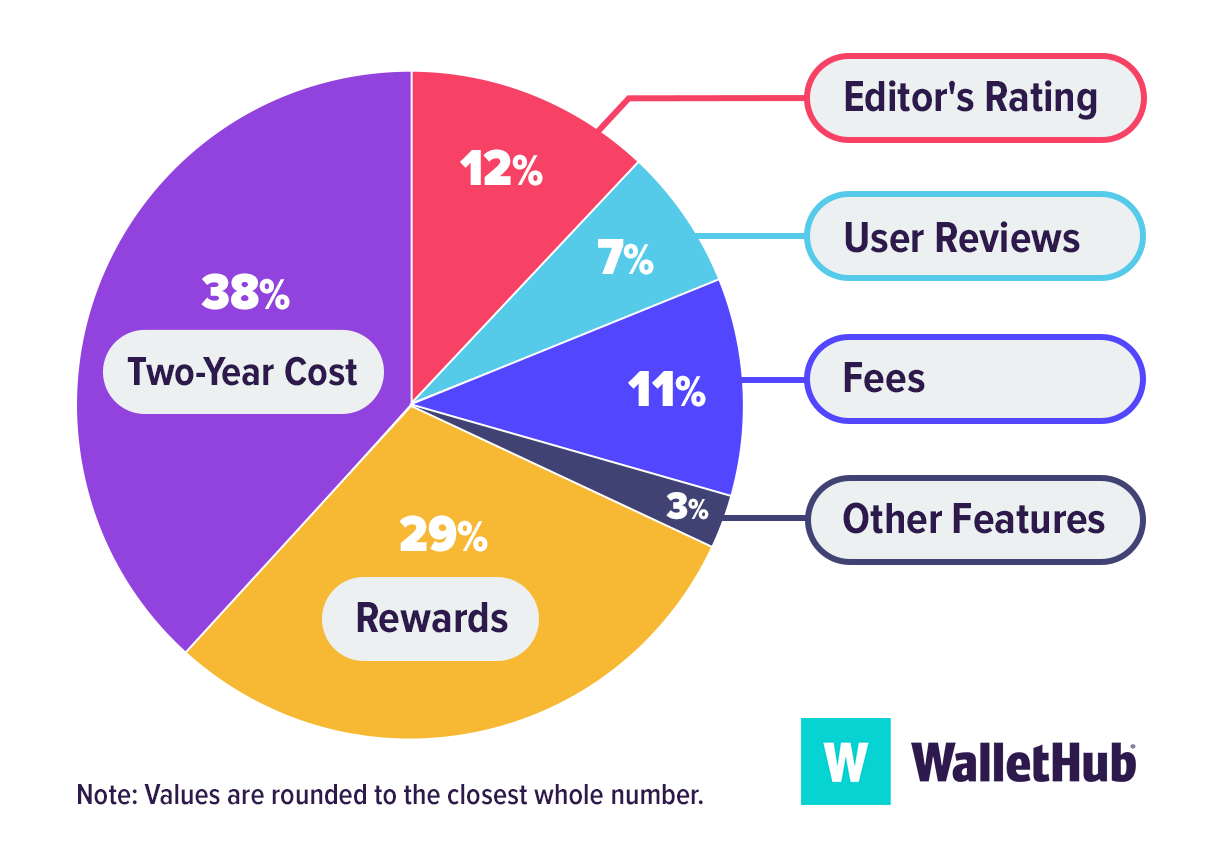
Two-Year Cost: 38% – We look at the overall value each card delivers over two years by comparing its annual fee to the rewards a business is likely to earn and the other savings it’s likely to glean from the offer. Cards that offer dependable value across a range of typical business expenses tend to perform best in this category.
Rewards: 29% – We review how each card distributes rewards, including standard earning rates, bonus categories, redemption choices, and redemption values.
Editor’s Rating: 12% – Our editorial team compares each card within the American Express business lineup and against similar products from other issuers. We emphasize overall value and how well the card fits into a business owner’s broader financial setup.
Fees: 11% – We consider the full range of costs tied to each card, including annual fees, monthly charges, and foreign transaction fees. Cards that minimize costs while still offering strong benefits receive higher scores.
User Reviews: 7% – We factor in feedback from business users to capture day-to-day experiences, including customer support, ease of account management, and satisfaction with rewards and features.
Other Features: 3% – We evaluate additional benefits that can support business operations, such as tools for managing employee spending, integrations with accounting software, travel and purchase protections, and extended warranty coverage.
We also highlight other cards for specific strengths, such as introductory APR offers or suitability for newer businesses. In these cases, we adjust our methodology to better reflect those particular advantages.
How Two-Year Cost Is Calculated
Two-year cost is used to calculate the monetary value of cards for better comparison and is calculated by combining annual and monthly membership fees over two years, adding any one-time fees or other fees (like balance transfer fees), adding any interest costs, and subtracting rewards. Negative amounts indicate savings. When fees or other terms are presented as a range, we use the midpoint for scoring purposes.
Rewards bonuses and credits have been taken into account for two-year cost calculations. However, bonuses applicable to only a very small portion of cardholders are not considered. For example, credits and bonuses awarded for spending or redeeming rewards through a company portal with non-co-branded cards have not been taken into account. Similarly, bonuses and credits related to spending with specific merchants using a non-co-branded card have not been taken into account (for example, if Card A offers credits with DoorDash, this feature would not be factored into calculations because it is hard to assess how many cardholders would use the benefit or exactly how much value they'd get from it).
Cardholder Spending Profiles
Given that different users have different goals and are likely to use their credit cards differently, we identified spending profiles that are representative of different users’ financial priorities and behaviors. For each cardholder type, we have assumed a specific amount of monthly spending by purchase type (e.g., groceries, gas, etc.), as well as an average balance, balance transfer amount, amount spent on large purchases and average monthly payment. Spending assumptions are based on PEX data.